Pen of the Day: Sheaffer PFM Green with Kaweco Palm Green

Sheaffer PFM with Kaweco Palm Green ink

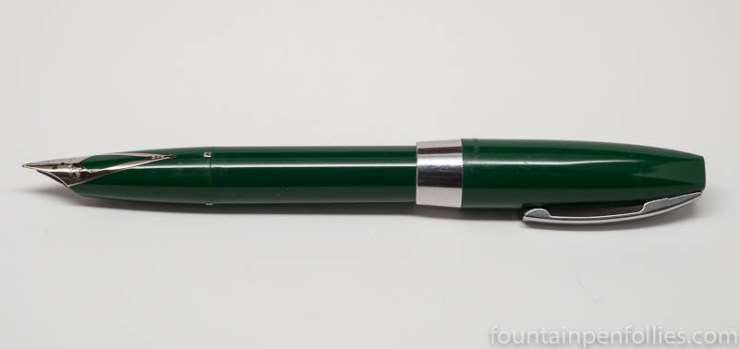
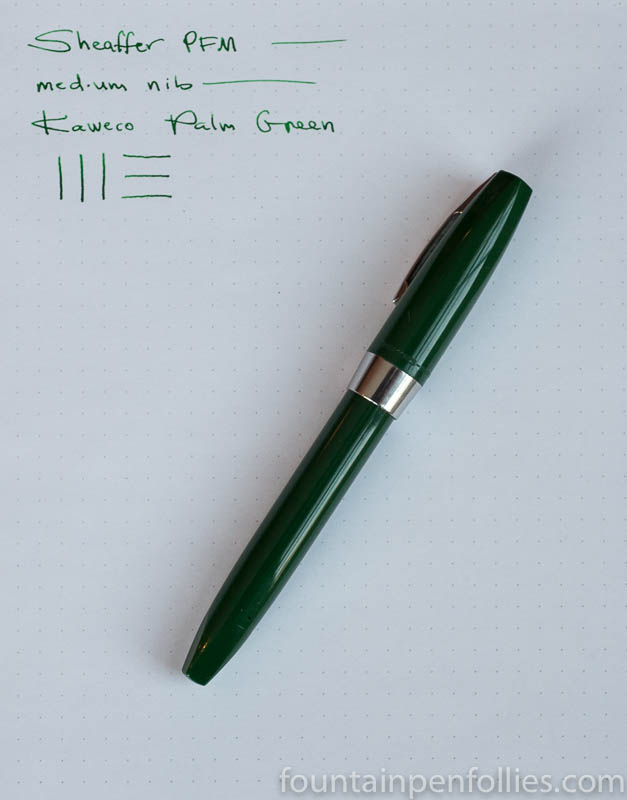
Sheaffer PFM Green with medium nib. I’m still rocking the holiday inks.

Here, it’s Kaweco Palm Green. In contrast to the more sophisticated Garnet Red ink that I filled last week, Kaweco Palm Green is an unabashedly kid-friendly color.

It’s the one your kindergarten-aged self would have pulled from the crayon box to color in the Christmas tree, on the construction-paper card you were making for mom.

Sheaffer PFM with Kaweco Palm Green ink

And it reminds me of gum drops.

miniature gingerbread house

New 2017 Lamy Al-Star Pacific

czexlmruuaaosi

Thanks to Fontoplumo, we know the upcoming 2017 Lamy Al-Star will be this blue shade, called Pacific.

At first glimpse, I really like the color. It’s almost an Al-Star version of the no-longer-available Lamy Safari Aquamarine. Which is excellent.

I found this photo on Fontoplumo’s Twitter, which gives me the chance to say that Fontoplumo is another very nice store, from the Netherlands, from whom I’ve purchased before and will again. I’ve actually bought some of my Al-Stars and Safaris from Fontoplumo, because they have excellent prices and the European stores usually get the annual Safaris and Al-Stars first.

————

Photo from Fontoplumo Twitter, here

Pen of the Day: Pelikan M600 Ruby Red with Graf von Faber-Castell Garnet Red

Pelikan M600 Ruby Red fountain pen and Graf von Faber-Castell Garnet Red ink

Pelikan M600 Ruby Red with fine nib. Winter weather’s here, with days dark and drear. Perhaps a new ink might bring some good cheer.

Outside Fountain Pen Follies world headquarters, cold and snow have arrived. Which of course means it’s time for the long-awaited limerick contest winter ink colors. Time for the jewel tones, the dark and rich hues, the seasonal shades.

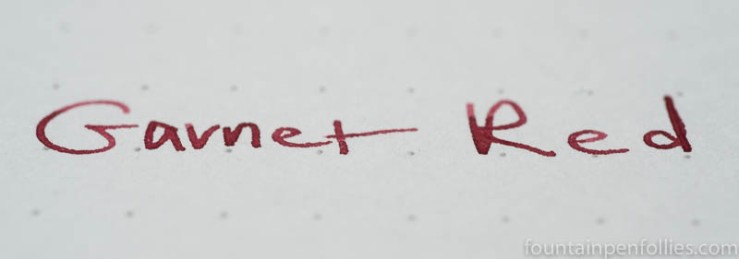
My first choice this year is Graf von Faber-Castell Garnet Red. I originally tried Garnet Red, and wrote a brief review, last winter. Garnet Red on white paper makes me think of red berries silhouetted against snowy ground.

Graf von Faber-Castell Garnet Red writing sample

Garnet Red is an attractive, business-appropriate maroon or cranberry.  I always love an ink that shades. And Graf von Faber-Castell has a great ink bottle. As a fellow blogger recently pointed out, a bottle of premium ink would make a great Christmas or Hanukkah gift. Start hinting.

I do like my Pelikan M600 Ruby Red with maroon inks. The pen’s acrylic is a mix of the right kind of dark reds.

Pelikan M600 Ruby Red fountain pen closeup

A Review of the Lamy Lx in Rose Gold

Lamy Lx Rose Gold fountain pen

Lamy Lx Rose Gold with medium nib. Clearly under the influence of too much Thanksgiving pie, as well as the word “sale.” I succumbed to Black Friday frenzy and ended up with a Lamy Lx in Rose Gold with a medium nib. And now it’s here.

I think the Lx is a very nice-looking pen in rose gold. The Lx nib writes noticeably more smoothly than the normal Safari nib. But I don’t like the Lx so-called case. And I think the Lx price is easier to justify if you’re buying it as a gift, or you are a new user, or you have a serious yen for one of the colors.

(click Page 2 below to continue)

Cool Pelikan Video 

For fans of How It’s Made, here is a video showing the manufacture of Pelikan fountain pens.

Some things have changed since this was filmed: I think Pelikan no longer makes its own nibs, and I know Souveran cap medallions are metal now. But I am impressed by how careful and labor-intensive the process was, and probably still is.

I found the link on FPN. Many thanks to the poster.

Fountain Pen Favorites for November 2016

calendar image

November 2016 kicked off with the best World Series in 108 years, for a Cubs fan. And when it came to fountain pens and ink, the rest of the month was pretty darn good, too. Here are my fountain pen highlights.

1. Sheaffer Targa Green Moiré. The grand slam.

2. Some Great Inks. Montblanc Golden Yellow, a new KWZ, Bung Box Sweet Potato Purple, Bung Box Dandyism. Wow. And if the rain ever stops here, I’ll be able to take photos.

3. Columbus, Ohio. I had a great time at the Ohio Pen Show. I’ll list some favorite things. First, being able to consult Richard Binder, Ron Zorn and Dan Smith. Also, Tim Hofmann’s coffee. Hanging out with friends. The pho restaurant. Robert Mason Co. And above all, the nice people of Columbus and Ohio State. Thinking of you today, Columbus.

——————

Photo by Dafne Cholet, Flickr, used under Creative Commons license.

Pen of the Day: Sheaffer PFM I in Green with Caran d’Ache Delicate Green

Sheaffer PFM I green

Sheaffer PFM I with medium nib. For my friend Jon, here’s my second PFM I, and first working one. It’s green, because, apparently all my pens now must be green. When I got this one, the nib wasn’t really writing well. It was a little misaligned, a little out of whack.

No worries. Because it’s a Sheaffer inlaid nib — which means, not like other nibs — and because I was going to the Ohio Pen Show, I took it to Ron Zorn. Ron did a little of this and a little of that (I was chatting), and boom, all fixed. He’s the Sheaffer master.

Sheaffer PFM I green

Probably it’s heretical, but I like the PFM I’s stainless-steel colored trim and plastic cap best of all the models. And the green. The PFM green is an unusual color. It’s not a forest green, but more a dark medium green. It usually looks lighter than in that photo.

Believe it or not, I don’t love the color green. And the PFM green isn’t conventionally attractive (to me). In fact it feels dated (to me). Paradoxically, that’s why this is my favorite. The blue, maroon and black PFMs are conventional colors, and more conventionally attractive. But the green is a little odd, and a little retro. It fits the pen.

So basically, I think the green PFM I is the coolest PFM, because it’s the most PFM.

And right now, it’s filled with my favorite green ink, Caran d’Ache Delicate Green. Which is really too pretty for this pen. But, hey, it’s almost the holiday season. It gets to dress up for a bit.

Sheaffer PFM I green with Caran d'Ache Delicate Green


Richard Binder’s Nib-Smoothing Workshop at the Ohio Pen Show

Richard Binder's Nib Smoothing Workshop materials

One of the highlights of the Ohio Pen Show for me was a nib smoothing workshop given by Richard Binder, with help from Linda Kennedy of Indy-Pen-Dance and Brian Gray of Edison Pens.

I pre-registered and paid $20 for the materials, shown above, and for the workshop. There were probably about 18 slots for paid participants, but Richard let anyone else audit the class from seats in the back.

It was really worth it, and I highly recommend it. According to Richard Binder’s website, the next show he and Barbara will attend is Baltimore on March 3 through 5. If I were in the area, I’d keep checking Baltimore and other upcoming shows for the seminar.

Richard also has a wonderful website, and I’ve spent a lot of time over the years looking through the reference pages and the blog. You can find the reference pages here. A lot of what Richard talked about in the seminar can be found in his writings about nibs, just organized differently.

I can’t teach anything about nib work, myself, but I thought I’d share a few of the workshop’s biggest lightbulb moments for me, in hopes of helping someone else.

The workshop covered the basics of nib alignment, tip shapes and nib smoothing. Richard talked about the principles, then had us practice, while Richard, Linda and Brian walked around giving individual instruction.

I learned some interesting things about loupes. For basic nib adjustment and smoothing, Richard recommends a loupe between 7x and 12x. He emphasized that an unlighted loupe is better for nib evaluation and adjustment, to avoid reflections. If, like me, you already have a lighted loupe, just keep the light off when working on nibs.

The first step is to hold the loupe and pen in the right orientation. That’s basic, but believe it or not, it was also the hardest for me and the people around me to do consistently. Richard counsels that you should hold the loupe up to your eye and look straight ahead, at the wall essentially. Then you hold the pen in your other hand, at a 45 degree angle, nib toward the ceiling (at that 45 degree angle), with the top surface of the nib facing toward you and the feed side facing away. You move the nib in that position toward the loupe until the nib tip is in focus.

That was hard, for this rank amateur, because it felt odd: you’re only seeing a very small portion of the nib tipping.  My instinct, and that of most of us, if we weren’t being conscious of following the directions, was instead to hold the nib more straight on, so we saw more of the tipping material. Or even to bend our necks and look down at the nib from above, again seeing more of the tipping material. Before the class, I would have held the nib pointing straight up and with the feed directly facing me — which lets you see a lot of tipping material, but is pretty much the opposite of what Richard counsels.

Richard explained his reasoning: when you hold the nib at a 45 degree angle, with the feed facing away, and look across the top, what you are seeing is the part of the nib that touches the paper when a person writes with the pen at a 45 degree angle. You are forcing your perspective to be that of the paper. And that makes perfect sense. It was an aha moment. This way, you are checking that the nib is perfectly aligned where it hits the paper.

As an aside, not everyone holds a pen at a 45 degree angle — I for one write at a steeper angle. So keep that in mind. (It’s also really important to mention your writing angle when you’re asking for nib work, or buying a new pen from someone who’ll adjust it to your preferences.)

Another key lesson, that was helpful right away, because I bought something at the pen show, is to know that modern, newly manufactured nibs can frequently have issues out of the box. After the workshop, I knew enough to look at my new nib before trying it, and sure enough, it needed a slight adjustment in the slit alignment.

What is slit alignment? The slit in the nib should be tapered from the breather hole to the tipping, so that the slit is wider at the breather hole and narrower at the tip. And you should be able to hold the uninked nib up a light source, look through your loupe and see light through the (hopefully tapered) slit all the way along. If the slit alignment is not correct, you can adjust it by moving the tines gently with your finger nails. That’s fairly easy to fix, but I hadn’t really been conscious that I should check for it on new pens.

And that’s a key word: conscious. I think after taking the seminar I have a better sense of the nib and how so many little things come together in the writing experience.

Back at the workshop, we also practiced gently adjusting tines if they are out of alignment at the tip, by moving one of the tines. My practice pen gave me a run for my money there. It kept jumping back out of alignment when I smoothed the nib on the buff stick or the mylar sheet. In a way, that was frustrating, but in a way helpful, because I started to be able to tell right away when the nib was out of alignment again. There’s a distinct kind of scratch when one tip is above the other.

And that brings up another critical lesson: whatever you are doing on a nib, keep double-checking that the step you just took didn’t undo a previous step. For example, if you spread the tines for a wetter flow, make sure you didn’t misalign the tines accidentally. If you did, realign, then go back and double-check the flow. And so on.

Nibwork is clearly one of those things you learn, and improve, by doing. But I feel like having Richard Binder’s instruction gives me a solid base from which to go forward. It was very gracious of Richard, Linda and Brian to share their knowledge and time in this way. I think that’s the spirit that represents the best of the pen community.

Doubling Down: Pelikan’s Double-Broad Highlighter Nib Isn’t Just for Highlighting

Pelikan M205 with double broad BB nib

That is the Pelikan double broad nib I bought at the Ohio Show this weekend from Dan Smith, the Nibsmith. I put it on my M205 Blue demonstrator.

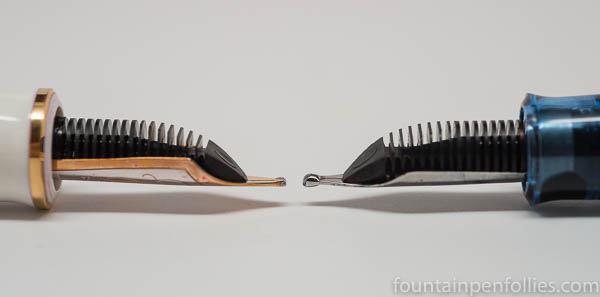
I don’t know if the size of that tipping material can be adequately appreciated, but there’s a lot. I call the nib The Blob. In a good way.

Here is a comparison of an M600 BB nib on the left with the M205 BB nib on the right.

Pelikan M600 BB versus M205 BB highlighter

And the other side, again with the M600 BB nib on the left and the M205 BB nib on the right.

Pelikan M600 BB versus M205 BB highlighter

I’m guessing that Pelikan wanted to make the M205 BB more round for highlighting. That said, I first tried a Pelikan M205 Highlighter fountain pen at the Chicago Pelikan Hub, and that nib was more stubbish than mine.

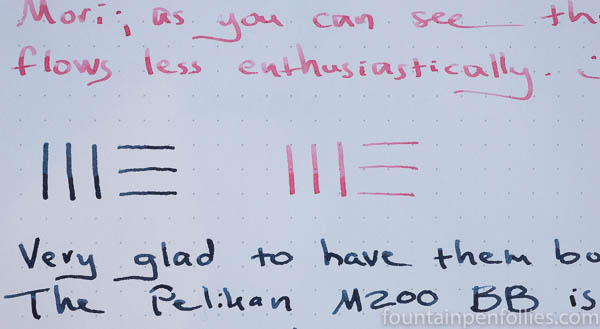
Having seen the nib, you won’t be surprised that it writes a gigantic line. It’s almost marker-like, and very smooth. It’s kind of fun writing with such a wet and wide nib. Also good for making your points forcefully. Or writing with yellow ink.

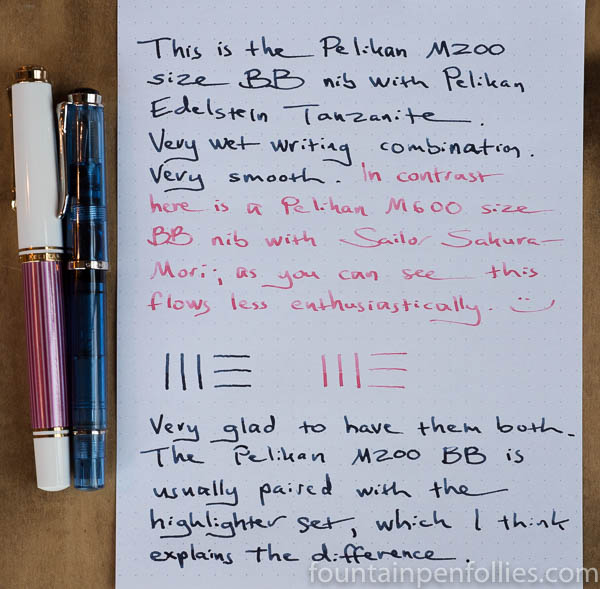
Here is a writing sample with the M205 double broad writing in blue and the M600 in pink.

writing sample Pelikan M600 BB versus M205 BB highlighter

The M205 has Pelikan Edelstein Tanzanite ink, which is a wetter ink than the Sailor Sakura-Mori in the M600. But the M205 double broad is just bigger, and it writes wider.

writing sample Pelikan M600 BB versus M205 BB highlighter

I’m a person who loves a good fine nib, but I think most fountain pen people prefer broader nibs, and this makes an intriguing choice. Because you can buy this one separately. And it will fit into any Pelikan from M200 through M700.

In the US it’s $60. Which means every else in the world it’s probably only $20 or less. (A little black humor, for those of us in Chartpak territory.)

I decided to buy the nib only. You could instead buy it on the highlighter pen. Or if you’re buying a different new M205, ask for the BB nib instead of the usual choices. I’d probably do that, if I ever bought another M200-sized pen, and I’d have the BB modified into a stub or architect’s nib. Because The Blob has tipping material to spare.