

I used Graf von Faber-Castell Cobalt Blue in two pens over three weeks: a modern Pelikan with extra-fine nib, and a Lamy Al-Star with broad nib. I eventually had to empty those, because how an ink cleans up is important for a review. But withdrawal symptoms were strong, so I put Cobalt Blue into a Montblanc with extra-fine nib. I think Cobalt Blue will be one of my standard blue inks now, along with a Caran d’Ache and a KWZ (or three).
Cobalt Blue is an ink that seems to be slightly on the dry side, writing a lovely thin line with an extra-fine nib. But Cobalt Blue is also wonderfully lubricated. So Cobalt Blue meshed well even with the dry-writing Lamy Al-Star.
Cobalt Blue is a standard blue, basically, but a bit darker and livelier. The color is business-like but cheerful. And it has beautiful shading. Here is Cobalt Blue on Rhodia, from the extra-fine nib.

And here is Cobalt Blue on cream-colored Tomoe River paper, from both pens.

This ink will sheen. A wetter pen will bring out more than a Lamy Al-Star, but the potential is there.
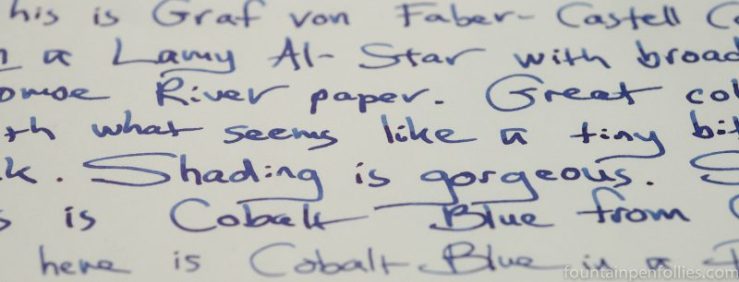
Cobalt Blue performed well on lower-quality paper, too. There was no bleedthrough. There was some showthrough on thin paper with the Lamy broad nib, but I still could use both sides of the page.
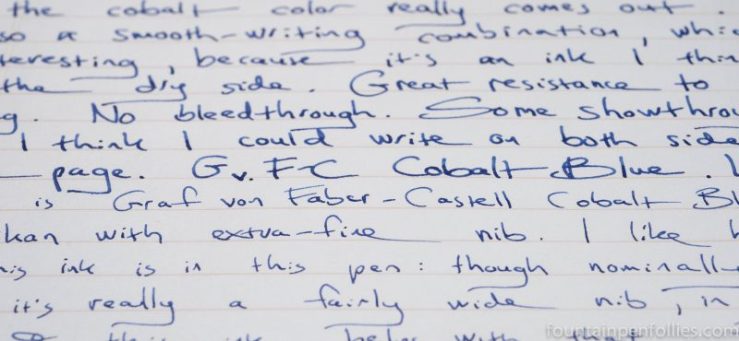
Here is Cobalt Blue on my everyday paper, Staples Sustainable Earth.

Cobalt Blue’s color and shading were excellent even here. The ink did not feather on Sustainable Earth. I saw some on my “everything feathers” copy paper, but only with the broad nib pen.
Cobalt Blue is darker than most standard blue inks, and at first I wondered if it might approach a blue black. Then I compared it to a favorite blue black, J. Herbin Bleu Nuit.
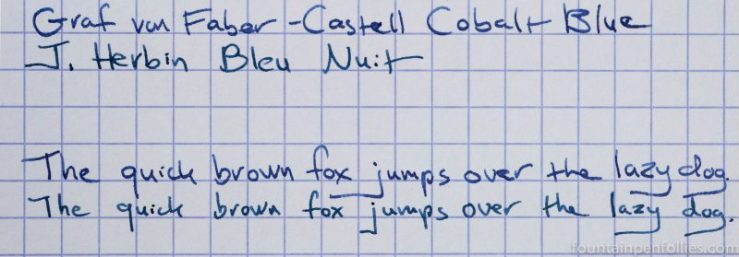
So, not a blue black. Blue black inks tend to lean green or gray, like Bleu Nuit. While Cobalt Blue really doesn’t.
Here is Cobalt Blue compared to a few standard blue inks.

Here are the inks that I own that I think are closest to Cobalt Blue, in one way or another.

None of these is identical. Cobalt Blue is darker than Aurora Blue, and Cobalt Blue is brighter and cheerier than the other two.
Whether Cobalt Blue is water resistant enough for you depends on your requirements. According to the company’s US website, Graf von Faber-Castell inks are “indelible,” which means Cobalt Blue is “smudge-resistant, reproducible, light-fast and waterproof, cannot be erased and is resistant to many chemicals and solvents.”
Here is how I do my water resistance tests: I write up the ink’s name on two small pieces of paper, one of which is normal paper and one of which is Rhodia dot paper; then I run water over the pieces of paper and let them dry. Here are the results with Cobalt Blue.

Cobalt Blue had excellent water resistance on normal paper. On fountain-pen friendly Rhodia, only a light purple core of Cobalt Blue remains. I personally find this fairly comparable to the water resistance of the last ink I reviewed, Kaweco Smokey Grey.
But Cobalt Blue cleaned up beautifully. It cleaned up so easily from both pens, after just flushing the pens briefly with water, that it called to mind Waterman Serenity Blue. Except Cobalt Blue has that water resistance.
Here is paper towel chromatography of Cobalt Blue.

I find two things very interesting. The main blue dye in Cobalt Blue is cheery and bright, but not the hue I would have expected. Also, I thought Cobalt Blue might contain a pink or red dye, but the other dye turns out to be a light purple. That is the purple that remained on Rhodia after the water test. I like how this combination turns into a dark blue.
Now a purple-leaning royal blue is not an ink for me. But Graf von Faber-Castell Cobalt Blue avoids that. It just looks blue.
It seems to me that Graf von Faber-Castell Cobalt Blue gives the user the best of all worlds, because it has the outstanding lubrication of a premium ink, the easy cleanup of a standard blue ink and the darker, brighter color of a modern ink. While also offering some water resistance.
It is expensive, though. The list price is $30 here. But at least you get 75 ml.
Also the bottle is really attractive.

 Fountain Pen Follies
Laura, I am a fan of Faber-Castell ink. I wondered how this ink performs. Thanks for letting me know I need to get a sample of this. You have a great blog here. I just subscribed to it recently.
LikeLiked by 1 person
That’s a really nice blue, a touch off the beaten path. And that bottle, the Cabinet of Curiosities demands one.
LikeLiked by 1 person
Good enough to be an everyday blue ink?
LikeLiked by 1 person
Totally. That’s how I’m using it. My only reservation would be how it would work in a very dry pen; however, I have none of those. 🙂
LikeLike
That’s good to hear. You’d think “blue” ink was pretty standard stuff, but there are some fantastic subtleties of shading out there. I’ve never really considered the Graf von Faber-Castell inks, but your last few reviews have left me thinking I should investigate them further. Thanks!
LikeLiked by 1 person