

I used KWZ Grapefruit in two pens, a custom Edison with medium nib, and a Lamy Safari with an assortment of nibs. Above is how it looks in the Edison.
Grapefruit is a wetter ink with good lubrication and flow. Startup was always instantaneous, and flow enthusiastic. In a wetter pen, on fountain-pen friendly paper, Grapefruit can take longer than average to dry.
Shading is not a big feature of KWZ Grapefruit; instead Grapefruit’s look is direct and strong. The dark orange color can look more restrained in an extra-fine nib, but with a broader, wetter nib, KWZ looks wild and fun — sort of like Hawaiian Punch, but in an ink.
Here is a writing sample on Rhodia from various pens and nibs.

The first pen used above is the Edison with a wider, wetter medium nib. Next is a dry-writing Lamy Safari with extra-fine nib. Third is my favorite pen for KWZ Grapefruit — a Safari medium nib that’s been stubbed and adjusted to write fairly wet. Finally is the Safari with a regular, unmodified broad nib.
You can see there’s a lot of variation depending on the pen and nib chosen. The ink looks nearly red with the Safari with medium stub. And darker orange with the Edison with medium nib. I like KWZ Grapefruit best from those two pens, which were the wetter writers I used.
Here are the same four looks but this time on Tomoe River paper.

KWZ Grapefruit did well on fountain-pen friendly paper, but it wasn’t perfect for me on normal, everyday paper. The color was good on lower-quality paper, but I saw a tendency to feather with wetter and broader pens. The exception was the Lamy Safari extra-fine, where I saw no feathering.
Here is a writing sample on Staples Sustainable Earth, my everyday paper.

More than the slight feathering, Grapefruit had a lot of showthrough on ordinary paper. I think that’s due to the wetness and saturation of the ink. Here is the reverse side of that Sustainable Earth page.

On thicker, fountain-pen friendly Rhodia, however, there was no showthrough.
KWZ Grapefruit had some water resistance on absorbent regular paper, but essentially none on Rhodia.

However, KWZ Grapefruit cleaned easily from my pens after just flushing with water. That’s nice for such a saturated ink, though probably not surprising considering its lack of water resistance.
I think it’s easiest to show what KWZ Grapefruit is, and isn’t, by comparing it to other inks.
First, KWZ Grapefruit is neither a classic orange or a classic red.
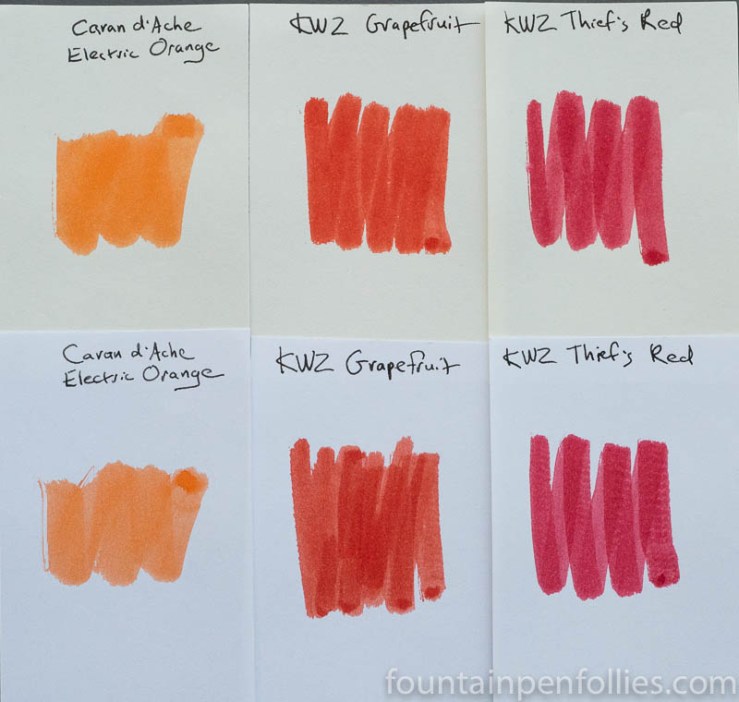
Compared there are my own favorite bright orange ink, Caran d’Ache Electric Orange, and KWZ’s standard red, KWZ Thief’s Red, which is very similar to Sheaffer Skrip Red.
Orange-red or red-orange is a colorway I enjoy, so I have a lot of those inks. Here is KWZ Grapefruit in a lineup of some favorites.
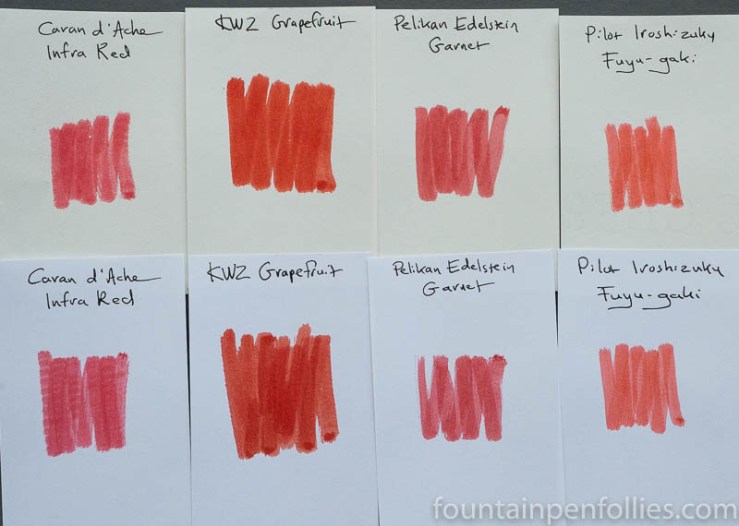
What’s striking to me is how much more orange, and how much more saturated, KWZ Grapefruit is.
One way of looking at that is that KWZ Grapefruit is stronger — which it is. Another way is that the others are more subtle — also true. The Caran d’Ache and Pelikans are redder, too. Perhaps because I’m a red fan, my own favorite of these four is Infra Red, which is redder and shades more than Grapefruit, but is very expensive.
Probably the closest comparison ink I have to KWZ Grapefruit is Pilot-Iroshizku Fuyu-gaki.

Both inks are an atypical and interesting deep orange color.
I did paper towel chromatography of Grapefruit, of course, and I was a little surprised at the results.

Those dyes are orange, pink and yellow. I would have expected more red, since I got such a red-orange color from the Safari with medium stub nib. But on reflection, it does explain Grapefruit’s unusual hue. It’s an interesting, creative color combination, and makes for a bright and interesting ink.
 Fountain Pen Follies
I have never eaten a grapefruit this color.
LikeLiked by 1 person
You’ll love KWZ Honey, though! It does look like honey. 🙂
LikeLike
I predict the trend continues until there is a line of “Prime Rib” inks that go from a pinkish-red hue all the way to a dark grey-brown (the famed “mother-in-law” color). The latter will be quite dry, of course.
LikeLiked by 1 person
I’m a vegetarian, but the mother-in-law color does describe my hair. 🙂
LikeLike
Texas has varieties of a dark reddish orange grapefruit. (South Texas I think) Maybe Konrad ate an imported one from there, and liked it so much he made a color after it. Doubtful, but it is possible. South Texas is where the best ones grow, really sweet too, for a grapefruit.
LikeLiked by 1 person
This review was a home run, without a doubt. I am going to have to try my Grapefruit in more pens. You clearly were getting more orange than I was. I used this ink in a medium pen, and it looked red, no orange at all. With a fine that is more like an extra fine, it was orange red. Orange red is what I wanted, so that worked out for me. I have tried Fuyu-gaki, and Infra Red too. KWZ Grapefruit (and maybe Diamine-Sunset) were the closest thing I found to Sailor-Amanita muscaria. I loved that ink, and can’t find it because it is a limited edition. (I think)
LikeLiked by 2 people
I use this ink daily since when I discovered it in 2013 🙂 🙂
LikeLiked by 2 people