Pen of the Day: Lamy Vista

DSC_3641

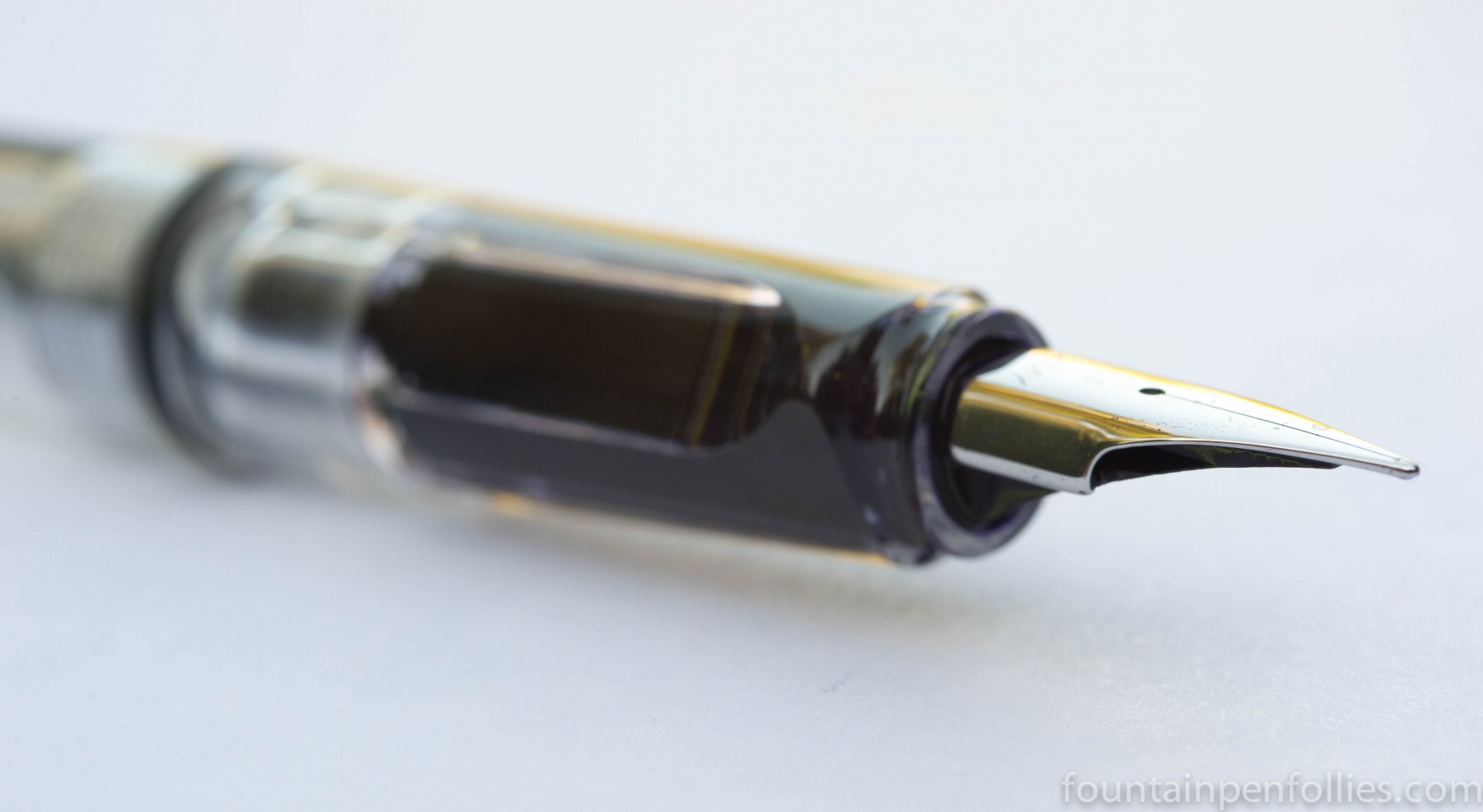
Lamy Vista with extra-fine nib. This is the demonstrator version of the Safari. I use an extra-fine nib by far the most of any nib on my Lamy pens. It’s the best size for my cramped writing.

DSC_3458

Despite my love for Safari pens, I resisted the Vista for years. Having a converter in a demonstrator pen seemed to defeat the purpose. But the minute I actually saw one, my opinion turned around. The converter only enhances the industrial syle of the pen, and I really like seeing it in there. Bonus points for the red knob.

DSC_3447

The ink is Waterman Purple, since this is, after all, purple week. It’s a nice, easy-to-read purple color. I’ve actually used it a lot this week to mark up documents, and the combination of pen and ink has been perfect for that. Purple has been good luck, as promised.

An Old Chicago Postcard

DSC_3499

A friend sent me this vintage postcard depicting the old Chicago Stadium.

I love seeing the old stadium. The stadium was opened in 1929 for the Chicago Blackhawks hockey team, who would later share it with the Chicago Bulls.  The stadium was known as the “Madhouse on Madison” because there were three close-in tiers of seats full of cheering fans, with a large organ providing sound effects.  It was the loudest, most exciting stadium I’ve ever experienced.

We call it the old stadium now, because it was demolished in 1995 and replaced with a newer building just across the street, the United Center, with an exterior modeled on its predecessor.

The old stadium hosted more than just sports, and it was one of those events that prompted the sending of this postcard.  In July of 1940, the 1940 Democratic National Convention was held at the Chicago Stadium, and President Franklin Roosevelt was nominated to run for his third term. The situation in Europe was dark: the Nazis had marched into Paris in June and were preparing for the imminent launch of the Battle of Britain.

Here’s the reverse of the postcard.

DSC_3500

“Greeting from the Convention,” from Arthur P. Schalick. The postmark is July 19, 1949, the day after the convention ended. Arthur P. Schalick turns out to be a local official from New Jersey who would later have a high school named after him.  I like the green ink he used.  I also like the trick of writing big when you have less to say.  That got me through a few exams in my student days, so I recognize a kindred spirit. I imagine he sent a stack of these to supporters and contacts back home.

It’s very nice to meet Arthur P. Schalick. I’m glad to have his postcard.  It makes me think of those days, and that great old building.

Pen of the Day: Lamy Al-Star Purple

DSC_3440

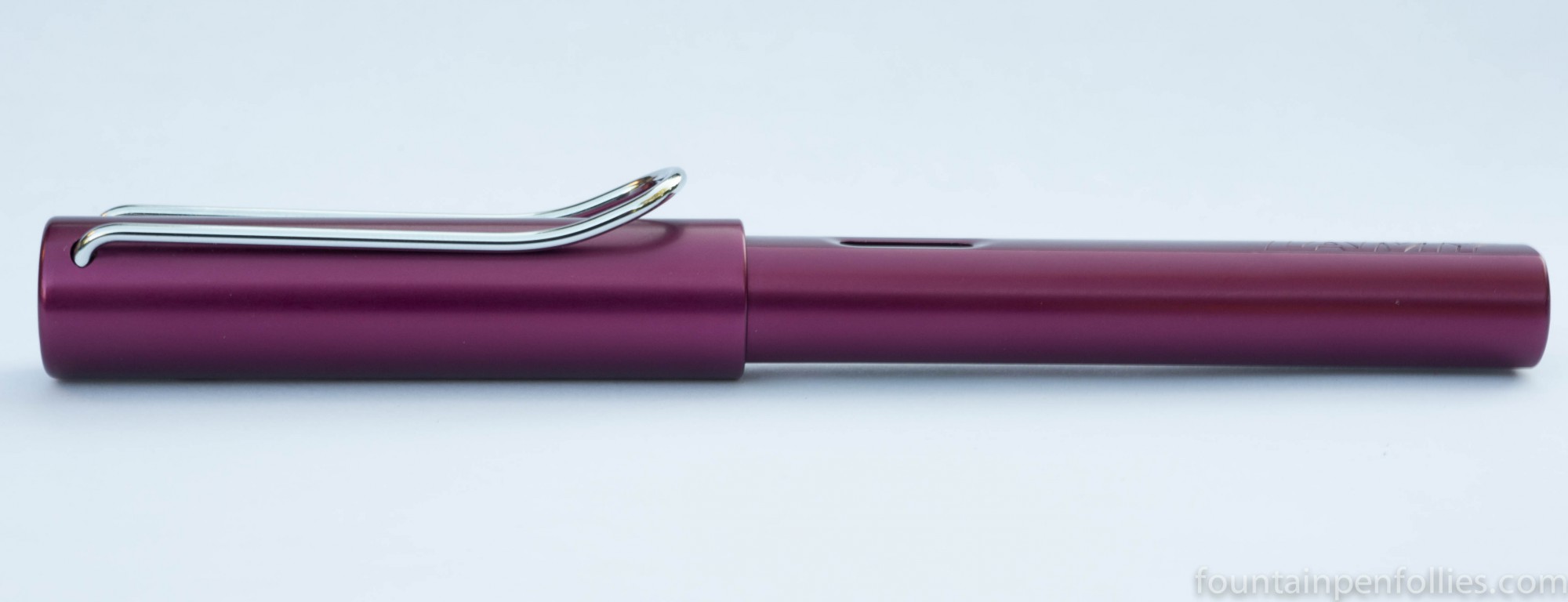
Lamy Al-Star Purple with fine nib. I’m still focusing on purple. This is Lamy’s idea of a purple pen, which is more my idea of a deep burgundy, but it’s a nice color. Sometimes we just have to roll with it.

I think the aluminum body of this Al-Star looks great with the silver clip.

DSC_3472

The ink is Sailor Kobe #32 Tamon Purple Grey. I really love this ink. Does it match the pen? Maybe not exactly. But sometimes we just have to roll with it.

DSC_3445

Purple Ink

DSC_3368

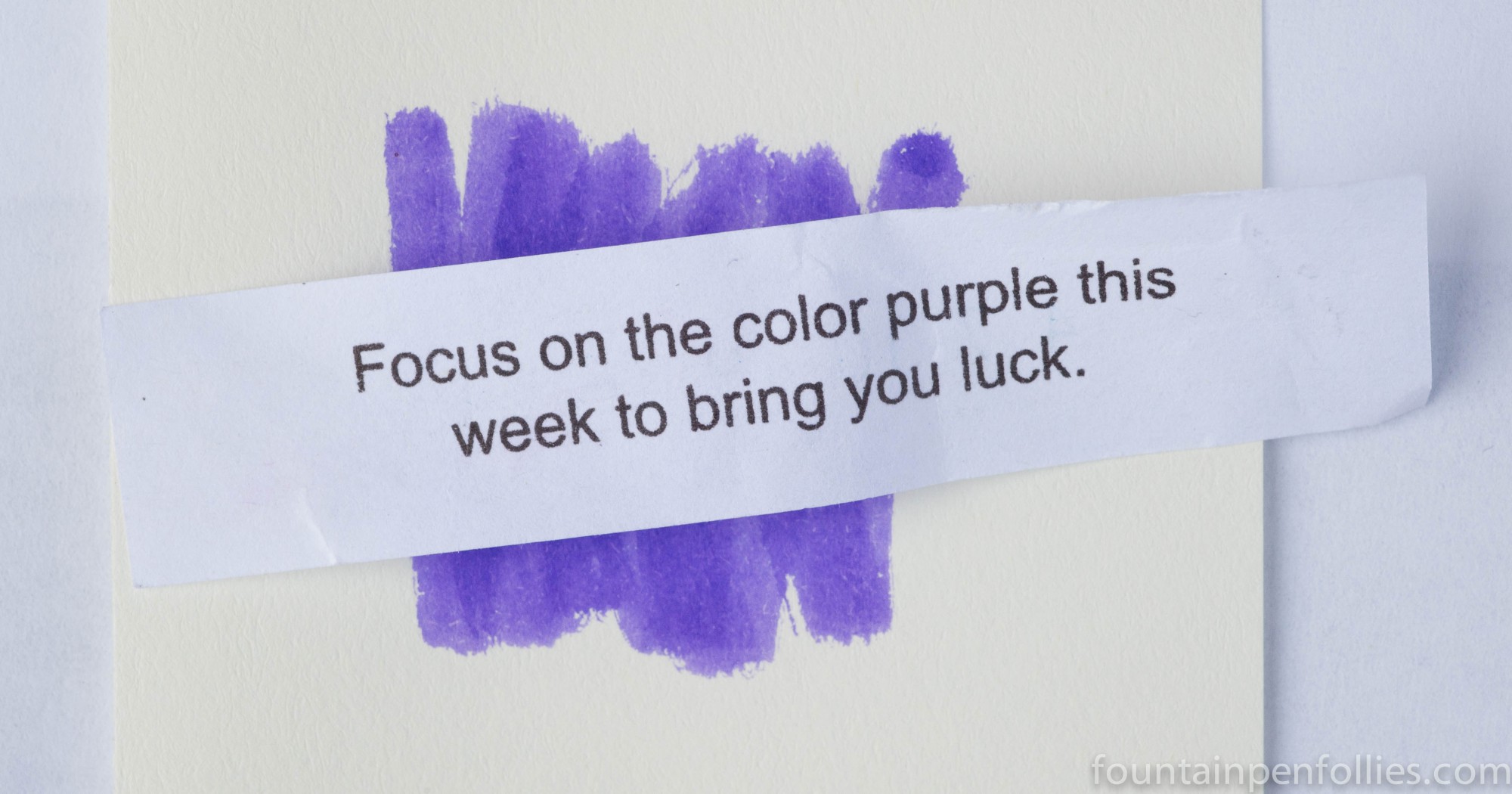
When fortune — or in my case, fortune cookie — speaks, I surely listen.

So, here is some purple ink. I hope it brings us all luck.

(click Page 2 below to continue)

Adrian Frutiger, Type Designer

Adrian Frutiger died recently at the age of 87.  Frutiger, from Switzerland, was a great designer of modern typefaces.  His fonts are known for their clarity and legibility: many of them were used in signage.

Frutiger didn’t just create typefaces; he thought deeply about them and was able to articulate his design principles as beautifully and clearly as he crafted his type.

He believed that a typeface should not draw attention to itself as a stand-alone work of art, but should be seen as a tool to best convey the underlying information.

“Type must be open and clear! It must be adapted to our lives. Type is the clothing a word wears, so it must be subordinate to the content.”

“The whole point with type is for you not to be aware it is there.”


To achieve these goals, he focused on his types’ proportions and on perfecting not only the lines of the letters but also the negative space — the spaces inside and around individual letters.

“Typography must be as beautiful as a forest – not like the concrete deserts of suburbia. A forest is not a single complex – there are distances between the trees which provide space to breathe and live.”

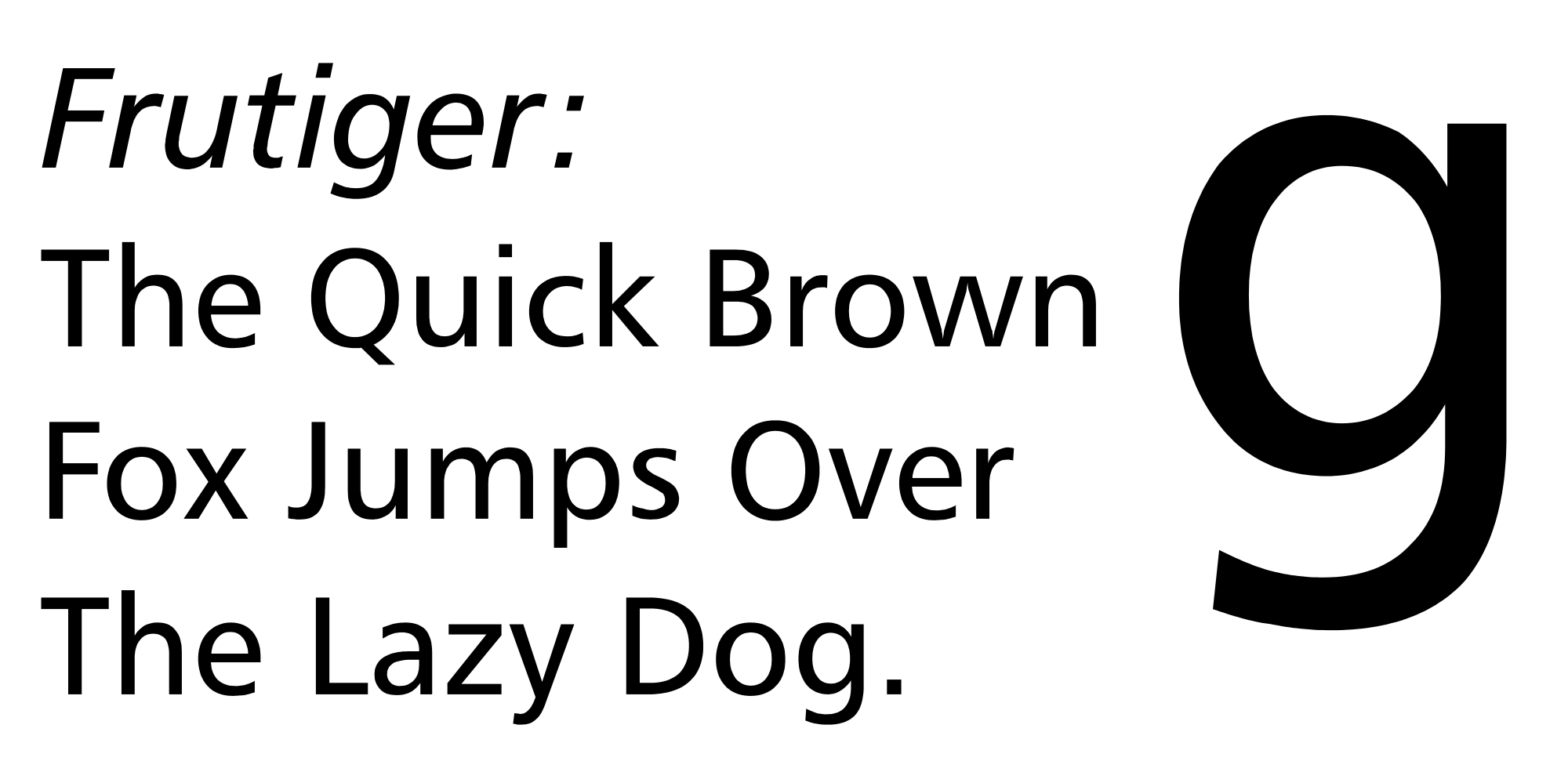
Among his most famous typefaces are Frutiger, illustrated first above, and Univers, second.  Both are used for signs in many public spaces — including the Charles de Gaulle airport in Paris, for Frutiger, and BART, the San Francisco Bay Area rapid transit system, for Univers.

Other notable Frutiger typefaces include the serif font Meridien and the sans-serif Avenir.


Avenir_Nameplate.svg


——————————-

Adrian Frutiger’s quotes are taken from an extensive piece about him on the Linotype website, which can be read in its entirety beginning here.

The Linotype piece is presented in the typeface Frutiger Neue, which I know thanks to a browser tool called WhatFont.  If you are a typeface fan like me, WhatFont is available for free here as a bookmark for your browser.

A New York Times obituary of Frutiger can be found here.

Just My Type, by Simon Garfield, a good general interest book about typeface design, talks about Frutiger, too, especially about his Frutiger and Univers typefaces.

The image of Frutiger type is by Dyfsunctional at English Wikipedia (Transferred from en.wikipedia to Commons.), via Wikimedia Commons.

The Univers type image is by Atanamir via Wikimedia Commons

The Meridien type image is by Fiamon via Wikimedia Commons.

The Avenir type image is by Fiamon via Wikiwand.

One Minute Ink Review: Pelikan Brilliant Black

DSC_2326

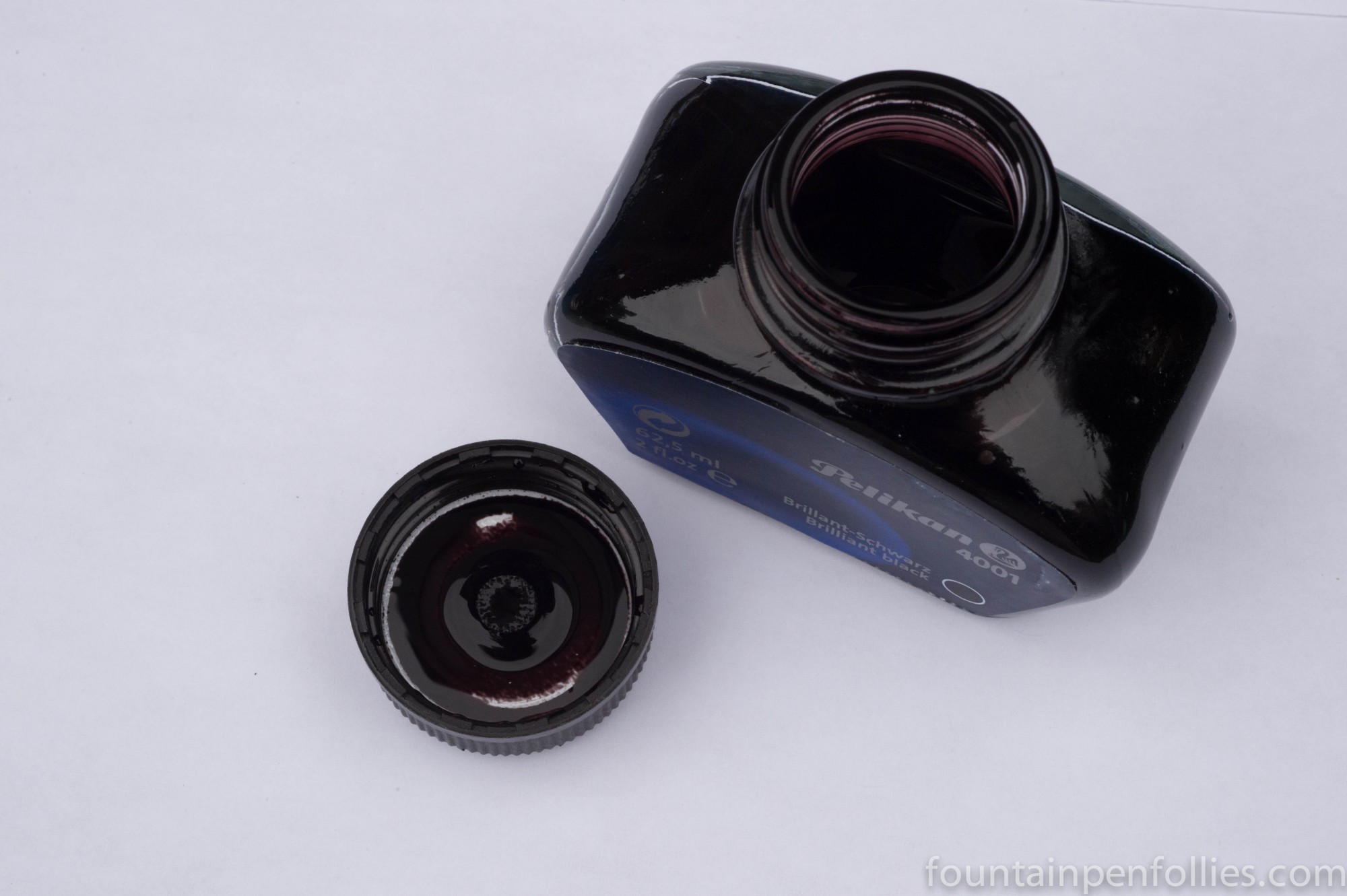
Pelikan Brilliant Black. A standard black ink that is a good bet if you have a wet writing pen or have to use poor quality paper. It has the nice quality of writing with a narrow line, which keeps your fine lines fine.  It’s dependable, reasonably priced and has very decent water resistance. But it’s also a dry ink, so with a dry pen it can look gray.

An everyday ink?  Absolutely, especially with wet pens or challenging paper.

Someone Great

Do you like LCD Soundsystem?  Me too!  I stole their song title.

Today is the 15th birthday of my youngest daughter, the dancer.  For her, here is something beautiful from the Russian dancer Sergei Polunin.

Pen of the Day: Montblanc Writers Edition F. Scott Fitzgerald

DSC_3288

Montblanc Writers Edition F. Scott Fitzgerald with fine nib.  I do own pens with bling.  This one, for instance.  I occasionally think about selling it, to pay for some other pens I’ve bought.  But then I use it, and immediately think, no,  I love this pen.

The Fitzgerald is filled with a Montblanc limited edition ink from a few years ago, Montblanc Albert Einstein ink. This is a gray that is so dark it can almost look black.  I love this ink, too. Using it actually rekindled my interest in black inks.

DSC_3292

The pen is more glamorous.  Its black, white and silver color scheme, its materials and its details pay homage to Art Deco style and to Fitzgerald’s Jazz Age.  It would look at home on the set of an Astaire and Rogers film.  And it’s a wonderful writer: the Fitzgerald is lightweight and comfortable, and mine has a superb, albeit wide, fine nib.

DSC_3312

I really love it, though, because it is the F. Scott Fitzgerald pen. Fitzgerald is a favorite of mine. Sadly, he died relatively young, with his career in shambles and his body of work uneven.  In his twenties, he had written a great American novel.  In his forties he died in reduced circumstances, separated from his wife and estranged from many of his former friends, thinking himself a failure.

On his and Zelda’s tombstone is engraved his famous final sentence from The Great Gatsby:  “So we beat on, boats against the current, borne back ceaselessly into the past.”  But in the novel, immediately before those words came these, of hope:  “Gatsby believed in the green light, the orgiastic future that year by year recedes before us.  It eluded us then, but that’s no matter — tomorrow we run faster, stretch out our arms farther…. And one fine morning —”

The dreamer’s eternal hope always was the other side of Fitzgerald’s vision. I think that’s the quality that endears him to us still, despite knowing that no matter how fast he himself ran, his talent could not outrun his demons.