
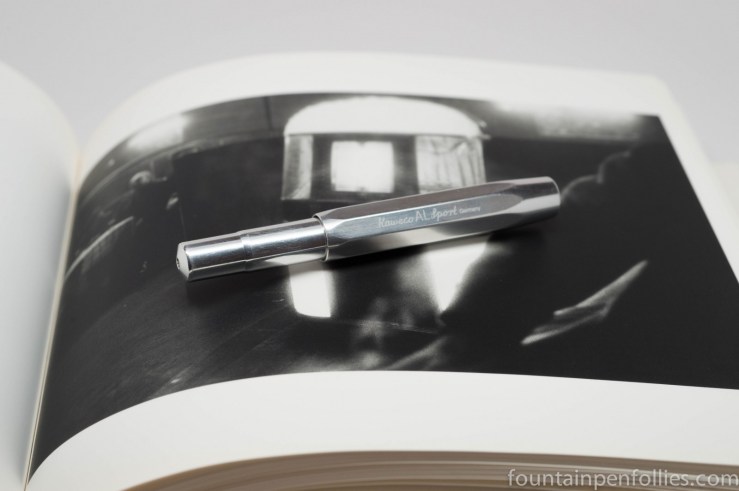
I love this pen. I made a strict and solemn vow to myself that I would not buy any other fountain pens this year. And then Kaweco loaned me this one to review. So just throw aside those good intentions, because I have to get one of these.
1. Appearance and Design. Gorgeous and striking.
The AL-Sport in raw aluminum is such a beautiful pen. Sleek and unadorned, it is almost pure form. The high gloss raw aluminum shows off the classic Kaweco Sport shape. The only decorative elements besides the beauty of the material are a small medallion on the end of the cap top and the Kaweco Germany script on the cap.
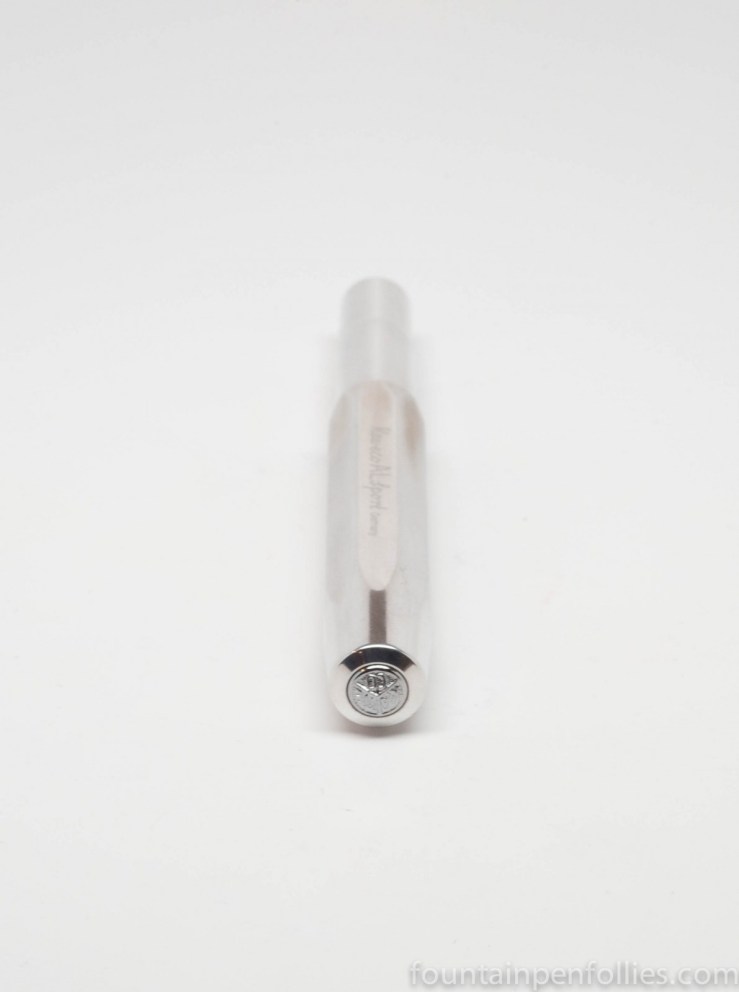
I loved it at first sight. And as the days have gone by, I keep picking it up and using it. I don’t care what I’m writing; this is the pen I want to use. And because I want to use this pen, I try to think of more things to write.
2. Construction and Quality. No issues.
I have a number of the basic plastic Kaweco Sports, and my son has used those for years. We’ve never had a problem. Occasionally the nibs have needed a little tweaking upon arrival, but that’s par for the course, and I’ve found Kaweco nibs easy to adjust.
With this AL-Sport, the high-gloss aluminum will scratch with use. In Kaweco’s words, “The pen gets its own character and patina due to scratches and chafes.” Kaweco warns people not to buy this one “if you don’t like scratches.”
Here’s an example of the most noticeable marks I’ve seen. It’s just normal wear, but perhaps the high gloss aluminum makes it more evident to some.

I Iike the marks, and I actually look forward to more. I like seeing an object change and become more personal with use and years. I think of our old dining table, a worn but comfy sweater or my mother’s old Parker 51.
3. Weight and Dimensions. Not too heavy, not too light.
Weight of the pen capped: 20.5 grams (inked). Because this is a mini pen, it’s designed to be used posted, so it’s a 20 gram pen. But even though I usually prefer lighter pens, I find the AL-Sport very comfortable and balanced in the hand.
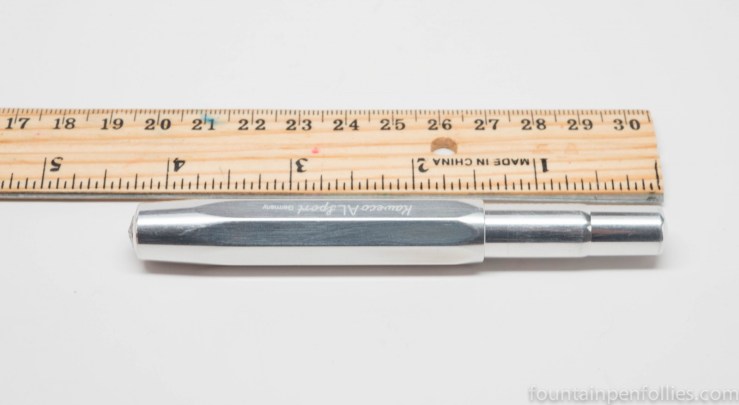
Length of the pen posted: about 5 1⁄4 inches or just over 13 cm.

Closed and capped it’s about 4 1⁄8 inches or less than 11 cm.
The section isn’t particularly wide, but I find it comfortable. It it about the same size as a Pelikan M200 section. However, because there’s more weight to the AL-Sport, I find holding the AL-Sport more comfortable.

The threads are not sharp, so if you like to rest your fingers there, you can. Sometimes I find metal sections slippery, but this one isn’t. In fact, I absolutely love using this pen for long writing sessions.
4. Nib and Performance. Excellent nib.
My loaner AL-Sport comes with an extra-fine nib. It’s truly extra-fine, and extra-nice to boot. Despite the nice narrow width, the nib was perfectly smooth out of the box. Ink flow is slightly above average. Line width is comparable to my Montblanc and Pelikan extra-fines.
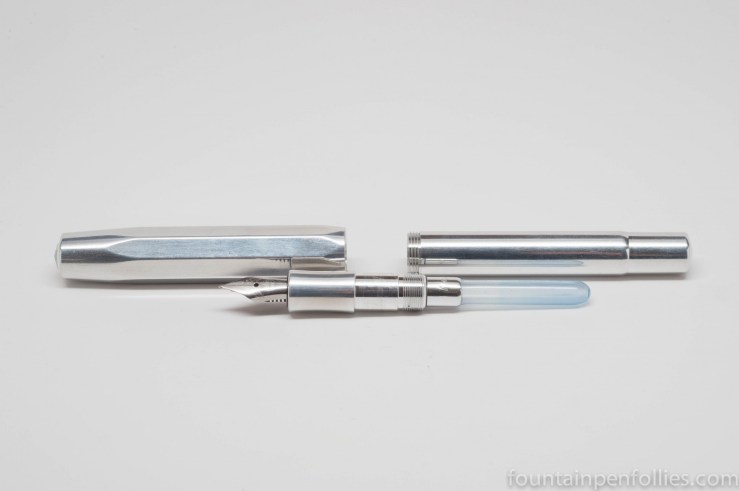
On this AL-Sport and other higher end Kaweco fountain pens, the nib units unscrew from the section. That makes cleaning easier and also lets you swap nibs between pens.
I pretty much only evaluate a nib for how it writes, but I know some people do wonder about size and looks, so I should say that the Sport nib is relatively small in size. Here it is compared to the Pelkan M200.

5. Filling System and Maintenance. International cartridge/converter.
This takes a short international cartridge or a Kaweco Sport converter, shown below.
This is probably my favorite filling system. It’s not fancy, but it’s great for a user: easy to clean and maintain, and allowing a lot of flexibility. International cartridges are convenient for travel, but you can use any ink with a converter.
I used both cartridges and converters in the AL-Sport. Interestingly, I found that filling the pen my usual way didn’t work so well in this pen, while a hybrid method worked perfectly.
My usual way to fill with a converter is just to attach the converter to the pen, submerge the nib unit in the ink bottle and use the converter to draw up ink through the nib and feed. With that method, however, the feed initially retained too much ink. That meant a wetter and wider line, and lots of nib creep for the first day after filling.
Conversely, I found that when I used a cartridge then the feed could be very slow to saturate if I just inserted the cartridge. The line would be too narrow, and the pen would be slow to get going at first.
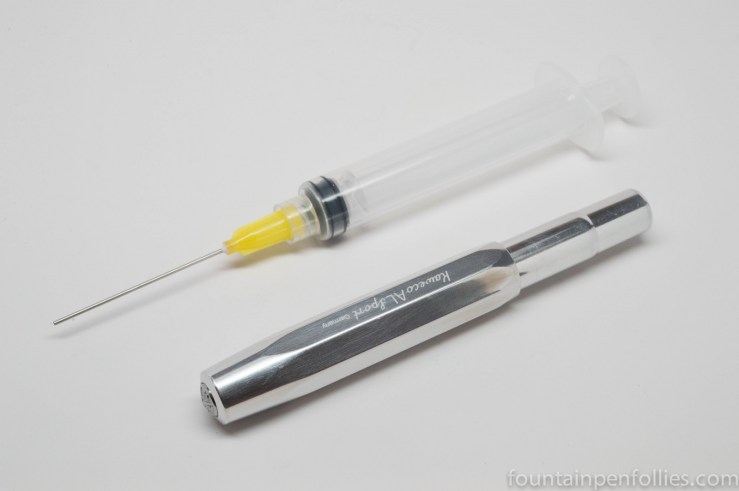
To avoid both problems, I used a syringe. With the converter, I’d fill from the syringe, and then syringe two or three small drops of ink onto the pen’s feed. With a cartridge, I’d pull a few drops of ink from the cartridge into the syringe, attach the cartridge, and then syringe the extra ink onto the feed.
Using a syringe primed the feed enough to write immediately, but without trapping too much ink in the feed. Filling the converter with a syringe also lets you get more ink in the small converter.
6. Cost and Value. Well worth it for me.
This pen costs $75 to $80 from US stores, and less abroad. A converter is $4. That’s a little more expensive in the US than the Karas Kustoms Fountain K or the Lamy Studio, which I think are comparable to the AL-Sport.
The AL-Sport is about $50 more than Kaweco’s basic model, the plastic Classic Sport. Even though the AL-Sport is not any different in writing quality than a Kaweco Classic Sport, the two are otherwise worlds apart. The AL-Sport feels and looks like a premium pen, while the Classic Sport is more of an excellent budget pen.
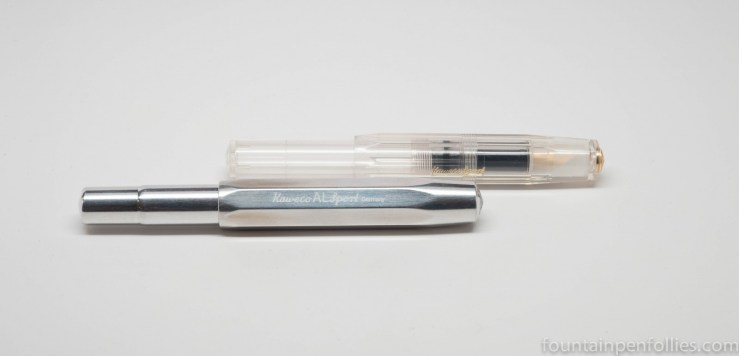
The AL-Sport material is aluminum rather than plastic, and it surprised me how that elevates the Sport design from “cute” to “wow.”
I wouldn’t stop using my Classic Sports, but the AL-Sport is just orders of magnitude more pleasurable, and so I think it’s well worth the price difference.
Pelikan’s M200 is another comparable pen, in my mind. The P200 cartridge/converter pen also would be, but I haven’t used a P200.

Everyone knows I’m a huge Pelikan fan, but I have to say that the AL-Sport has a higher quality feel to me than a Pelikan M200. The Pelikan M200 feels more like a student pen, or a stripped-down or basic model. The AL-Sport feels kind of special.
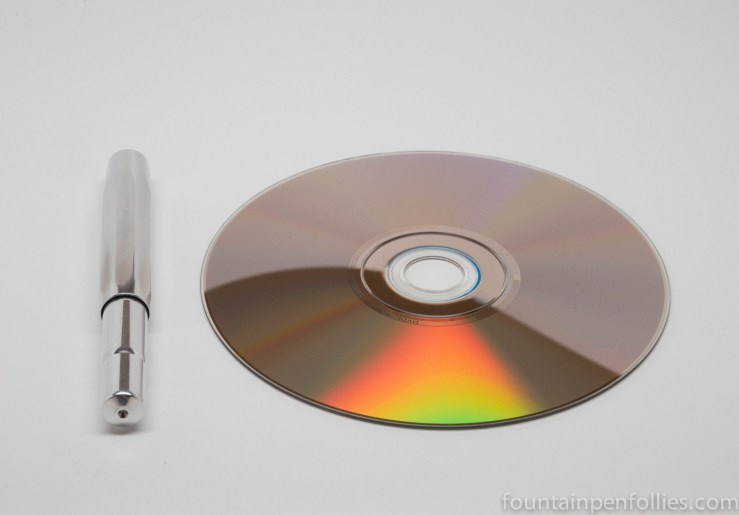
7. Conclusion. The minute I saw the raw aluminum AL-Sport, I fell for its looks. But I also love writing with it. It’s the whole package. Excuse the visual joke, but for me, it’s a perfect 10.
 Fountain Pen Follies
Is there any variant of the Al Sport that is resistant to scratches?
LikeLiked by 1 person
In my experience, yes. The two best would probably be the two “stonewashed” AL-Sports, in black or blue. They have a distressed finish that may not actually resist scratches, but since the finish is already distressed, you wouldn’t notice any new marks. Some of the others have a slightly textured, more matte finish (like the red and the light blue) — those two seem very durable. I also have the one Kaweco now calls Anthracite, I believe, and that has a smoother finish.
I don’t take special care of any of mine. In fact I keep them in a pen cup when they are inked. But I do carry them in a pen wrap or case outside the house. I haven’t seen scratching on any but the Raw Aluminum, which of course is designed to show wear. FWIW, the Raw Aluminum is still my favorite, followed by the black stonewashed. 🙂
LikeLike
<>
That’s the best kind of pen there is! And, I like a bit of scratching and denting – reminds me of the time I’ve had with a pen! Used but well-maintained is my favorite 🙂
LikeLiked by 1 person
sorry, the above was a response to where you said, ‘I don’t care what I’m writing; this is the pen I want to use. And because I want to use this pen, I try to think of more things to write.’ I just seem to have used some kind of html tag without realizing it. Wow, am I a prodigy or what 😉
LikeLiked by 1 person
You know what an “html tag” even is, so I’d say, “yes!”
LikeLike
Wow, and it would make an awesome weapon, too, 😉
LikeLiked by 1 person